Introduction
I use a Claude Code skill called /inspect for code reviews. It runs a structured 4-pass review: correctness, convention, security, and completeness. It works well.
Then one day I noticed something odd. Almost every time /inspect finished, I typed one more natural-language instruction:
inspect once more with a fresh eye
I had typed this more than 60 times. Even though I already had a skill. Why?
This post covers two things:
- How I mined 1.5GB of Claude Code chat logs with grep and Python to find an implicit skill
- The
/reinspectskill that came out of it, and the anchoring bias problem in AI code review
Background — The Signal of an Implicit Skill
/inspect was designed for the first pass. It runs a structured 4-pass review. It does its job.
But after it finishes, I keep typing “look at it one more time with fresh eyes.” That is strange. If I already have the skill, why not just run the same skill again?
Hypothesis: when I run the same skill in the same context, I get the same conclusion. So I had been using natural language, “fresh eye,” to push the AI into a different mode of reading.
The question: does that actually change the behavior? Or does it just feel better?
The Process
1. Mining the Chat Logs
Claude Code stores conversations as JSONL under ~/.claude/projects/<project-path>/. The CheckUS project had 1.5GB of logs across 630 files.
Reading all of that into context would be a token bomb. So I used grep and Python to extract only user messages:
import json
from pathlib import Path

base = Path("~/.claude/projects/C--dev-checkus").expanduser()
results = []

for jf in base.glob("*.jsonl"):
    with open(jf, encoding='utf-8') as f:
        for ln, line in enumerate(f, 1):
            if 'fresh eye' not in line.lower():
                continue
            obj = json.loads(line)
            if obj.get('type') != 'user':
                continue
            content = obj.get('message', {}).get('content', '')
            if isinstance(content, list):
                text = '\n'.join(
                    p.get('text', '') for p in content
                    if isinstance(p, dict) and p.get('type') == 'text'
                )
            else:
                text = str(content)
            # Only short user inputs. Long ones are usually transcript replays.
            if 'fresh eye' not in text.lower() or len(text) > 2000:
                continue
            results.append((jf.stem[:8], ln, text[:200]))

print(f"Total: {len(results)}")
Result: 60+ occurrences across 73 sessions over two months.
2. Verifying the Behavior — Was It Actually Different?
Typing the phrase 60 times was one signal. The important question was whether Claude actually behaved differently.
I found sessions where I ran both /inspect and a “fresh eye” follow-up, then compared the response patterns.
| Pattern | Frequency | Description |
|---|---|---|
| Fresh re-read | ~40% | Declares “fresh review from scratch” and rereads the full git diff |
| Subagent second opinion | ~30% | Dispatches a code-reviewer subagent and returns a severity table |
/inspect rerun |
~30% | Just runs the same skill again, with little value |
In about 70% of cases, it really did behave differently. The best results came from the subagent dispatch pattern because it used a separate context.
3. Hypothesis: AI Also Gets Anchored
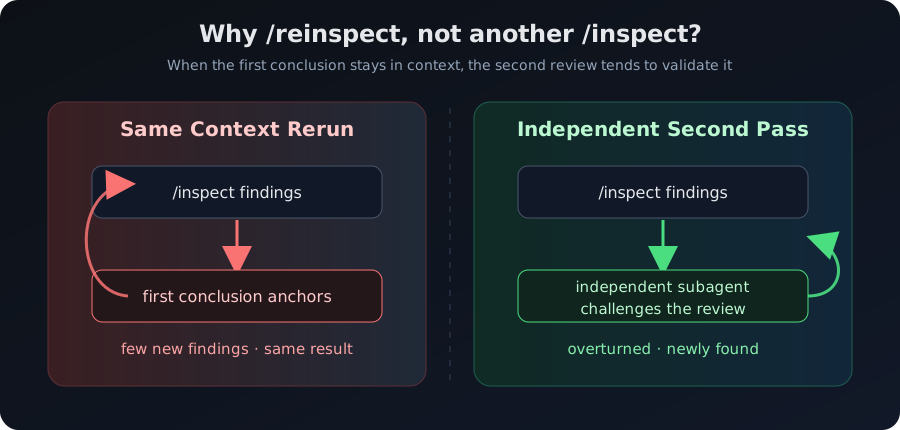
Why is rerunning /inspect in the same context weak?
Hypothesis: once the first pass conclusion is in the context, the second pass becomes biased toward validating that conclusion. This is similar to anchoring bias in humans: the first piece of information becomes the reference point for later judgment.
Evidence: in about 30% of cases, rerunning /inspect produced almost the same conclusion. Very few new findings.
Solution: use an independent context. Claude Code subagents do not inherit the parent session’s full context. Separate context means no anchor.
4. Writing the Skill
The skill lives at .claude/skills/reinspect/SKILL.md. The most important part is the description:
---
name: reinspect
description: Second-opinion pass for code review. Must trigger when the user says "fresh eye", "look one more time", "inspect once more", or similar. Do not rerun /inspect — the same context will hit the same anchor and return the same conclusion. Always spawn an independent code-reviewer subagent that actively challenges the previous review.
---
I also added an explicit anti-pattern section. The failure mode in 30% of cases was exactly “just run the same skill again”:
### Anti-pattern: rerunning /inspect
- /reinspect was invoked, but /inspect is invoked again (X)
- rereading git diff inline without spawning a subagent (X)
- listing the first review findings and confirming them without challenge (X)
The key instruction passed to the subagent is “challenge”:
Previous review conclusion:
{findings reported by /inspect}

Your job:
1. Read the full contents of the changed files. Do not rely only on git diff; diff context strengthens the anchor.
2. Challenge the previous review's conclusion.
   - Was any finding interpreted incorrectly? (overturned)
   - Did the first pass miss anything because it was anchored? (newly found)
Result
Before: I typed the natural-language instruction 60 times, and it produced the intended behavior about 70% of the time.
After: /reinspect and natural-language triggers both route into one consistent behavior.
The key was explicitly saying “do not rerun /inspect” in the skill description. Sometimes “do this” is weaker than “do not do that,” especially when two similar tools exist.
Lessons Learned
1. Repeated Natural Language Is a Signal for an Implicit Skill
If you keep typing the same phrase, that phrase is an unformalized workflow. Even if a skill already exists, the repetition means something is still missing. Find the missing piece, and it becomes a new skill.
This applies to LLM workflows in general. If you keep giving the same natural-language instruction, there is probably a skill hiding there.
2. Validate the Hypothesis With Data
Do not answer “is this really different?” by intuition. Answer it with logs. Even a 1.5GB log directory is manageable with grep and a small Python script.
I worried the investigation might cost more than it was worth, but the actual cost was around 10K tokens. The answer was worth much more than that.
3. AI Can Have Anchoring Bias Too
If you ask the same context to do the same task twice, it tends to see the same thing twice. If you need a genuinely different perspective, separate the context: subagent, separate session, or different model.
The same is true for human code review. If the same person reviews their own PR twice, they often see the same thing. A different person sees different things.
4. Naming Anti-Patterns Helps
If a skill description only says “do this,” the model may drift into a nearby tool. Adding “do not do this” makes the trigger sharper. This matters especially when similar tools coexist, like /inspect and /reinspect.
Comments