5/4 DB incident series
- When a cardinality=1 single-column index beats the compound index
- DB pool exhaustion cascade: do not mistake victim traces for causes
- Latent slow query incident: why “why today?” may have no clean answer
- 124 index anti-patterns found, 19 dropped — why the rest stayed
- JPA @Index is not prod DB index — 5 Entity-DB drift patterns
Introduction
After the index incident, we audited the database and found 124 suspicious indexes. The tempting conclusion was simple: drop them all.
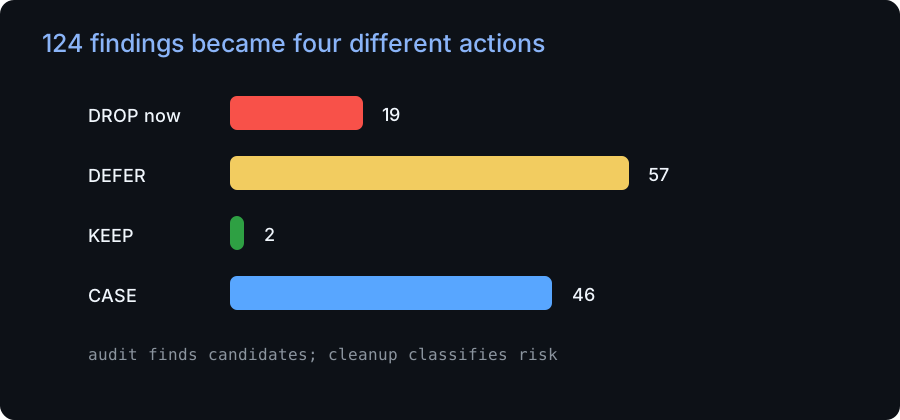
Reality was more careful: 19 immediate drops, 57 deferred decisions, 2 keeps, and 46 case-by-case items. Discovery and cleanup are separate decisions.
Audit Result
- Cardinality <= 2 single-column indexes: 92
- Redundant prefix indexes: 32
- Foreign-key columns without an index: 0
Decision Criteria
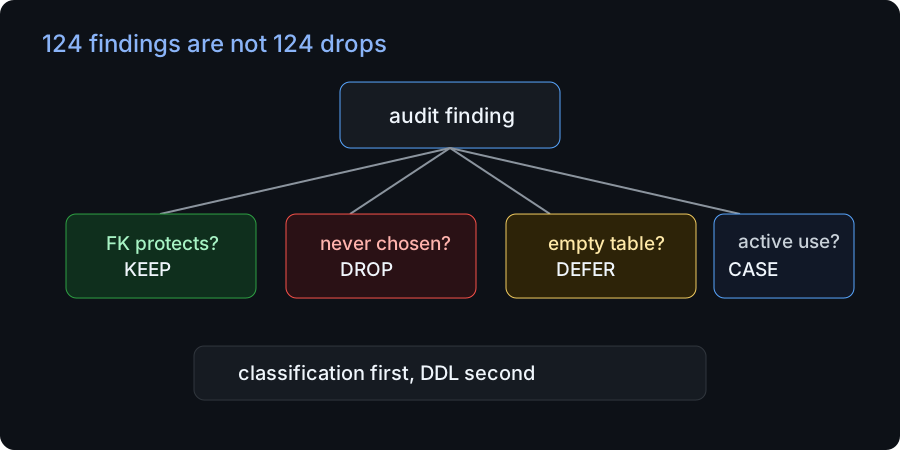
1. Foreign-key protection
InnoDB requires an index where the foreign-key columns appear as a leading prefix. If a suspicious index is the only index satisfying that requirement, dropping it is rejected.
ALTER TABLE operator_task DROP INDEX idx_template;
-- ERROR 1553 (HY000): Cannot drop index 'idx_template':
-- needed in a foreign key constraint
Decision: keep it, or replace it only when a justified compound index can take over the FK prefix role.
2. Never chosen by the optimizer
If an index appears in possible_keys but is never selected as key across real query patterns, it is pure maintenance overhead.
Decision: drop after prod-like EXPLAIN verification.
3. Redundant prefix
If a compound index starts with the same column as a single-column non-unique index, the single-column index is often redundant.
compound: idx_user_date_status (user_id, target_date, status)
single:   idx_user_id (user_id)
Decision: usually drop after before/after EXPLAIN verification.
4. Empty table
Many cardinality=0 indexes belonged to not-yet-active feature tables. With zero rows, there is no real optimizer behavior to judge yet.
Decision: defer until after the feature ships and data accumulates.
Result
| Classification | Count | Action |
|---|---|---|
| FK protection KEEP | 2 | keep |
| Never chosen DROP | 3 | drop |
| Redundant prefix DROP | 16 | drop after verification |
| Empty table deferred | 57 | decide after ship |
| Case-by-case | 46 | later phase |
Only 19 of 124 findings were immediate drops. That ratio is the point: audit rules find candidates; humans still classify risk.
Lessons
Classification first, DDL second
DDL is the last step. First decide whether the index protects an FK, is actually used, is redundant, or needs more data.
False positives must become explicit exceptions
If the coding convention says “no low-cardinality single-column indexes,” it must also say “except FK-protection indexes.”
Run prod DDL sequentially
Parallel ALTER TABLE DROP INDEX saved almost no time and made an error easy to miss in truncated output. Production DDL deserves one command, one response, one confirmation.
Next
Index cleanup naturally leads to the next question: does the entity model still match the real production schema? The next post covers five Entity-DB drift patterns.
References
- MySQL Reference Manual: FOREIGN KEY Constraints — Indexing
- MySQL Reference Manual: Optimizer Statistics
- MySQL Reference Manual: information_schema.STATISTICS
Comments