5/4 DB incident series
- When a cardinality=1 single-column index beats the compound index
- DB pool exhaustion cascade: do not mistake victim traces for causes
- Latent slow query incident: why “why today?” may have no clean answer
- 124 index anti-patterns found, 19 dropped — why the rest stayed
- JPA @Index is not prod DB index — 5 Entity-DB drift patterns

Introduction
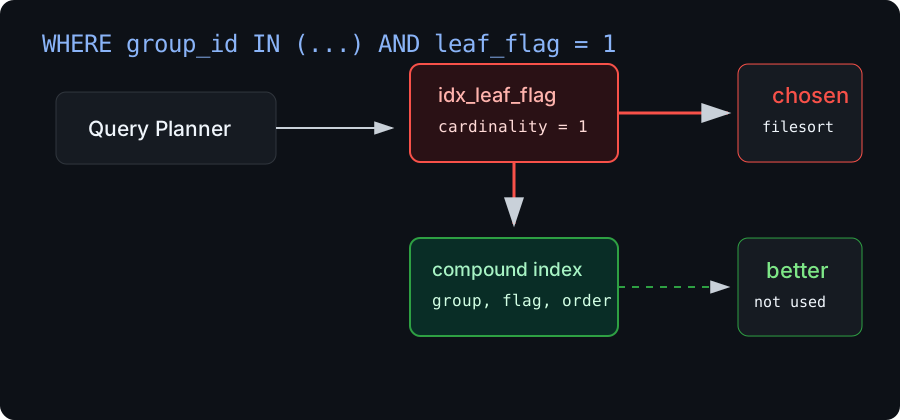
We added a compound index to speed up a query shaped like WHERE col_a IN (...) AND flag=1 AND enabled=1. But EXPLAIN showed that the optimizer ignored the new index. Instead, it chose an old single-column index on a boolean-like column whose cardinality was effectively 1, producing an execution plan close to a full scan.
This post records the trap, the mechanism, and the fix from a real prod P0 incident review.
Background / Problem
A latent slow query in a catalog table with hundreds of thousands of rows exhausted the Hikari pool during business-hour concurrency. Individual executions held a connection for 50 to 391 seconds. Twelve endpoints cascaded into circuit breaker OPEN.
The causal query:
SELECT id, group_id, parent_id, order_index, name
FROM item_catalog
WHERE group_id IN (?, ?, ?, ?, ?, ?)
  AND leaf_flag = 1
  AND enabled = 1
ORDER BY group_id, parent_id, order_index;
Existing indexes:
idx_group_id (group_id)                                       -- cardinality 8
idx_leaf_flag (leaf_flag)                                     -- cardinality 1
idx_catalog_roots (group_id, parent_id, enabled, order_index, id)
idx_catalog_children (parent_id, group_id, enabled, order_index, id)
idx_leaf_flag was a single-column index on a boolean-like field. In general, this kind of index has poor selectivity and little independent value. In this case, statistics error, ORDER BY/filesort cost estimates, and cost comparison between candidate indexes combined badly, and the optimizer judged the single-column path cheaper.
type: ref
key: idx_leaf_flag
rows: 293,871
Extra: Using where; Using filesort
Resolution
First attempt: add a compound covering index
We added an index aligned with filtering, ordering, and selected columns:
ALTER TABLE item_catalog
  ADD INDEX idx_catalog_group_leaf_enabled
  (group_id, leaf_flag, enabled, parent_id, order_index, id, name);
EXPLAIN still chose idx_leaf_flag. The new index appeared in possible_keys, but that did not mean it was actually selected.
Second attempt: ANALYZE TABLE
We refreshed statistics:
ANALYZE TABLE item_catalog;
The plan did not change.
Third attempt: drop the misleading index
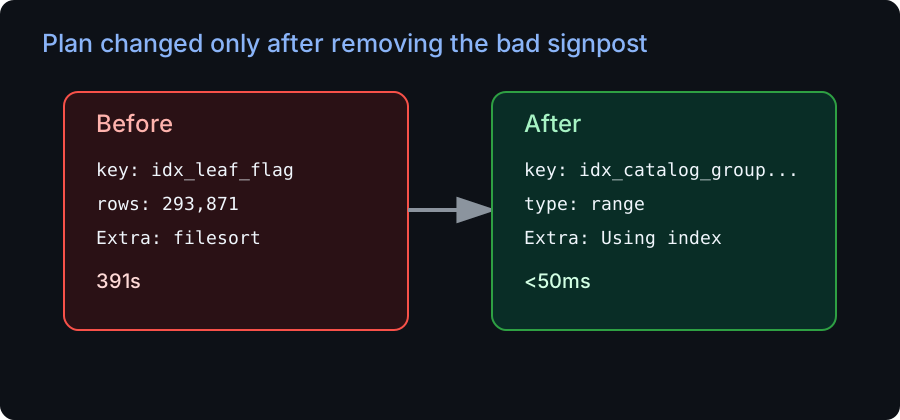
ALTER TABLE item_catalog DROP INDEX idx_leaf_flag;
The plan changed immediately:
type: range
key: idx_catalog_group_leaf_enabled
rows: ~200K estimated, sub-100K actual
Extra: Using where; Using index
Query time went from 391 seconds to under 50 ms.
Lessons
Low-cardinality single-column indexes are suspicious
A boolean or flag column should rarely stand alone as an index. It can still belong inside a compound index, but as a supporting column, not as the leading standalone route.
ANALYZE TABLE is not always enough
Statistics refresh can fail to change the optimizer’s choice. FORCE INDEX is one possible escape hatch, but in this case the old index had little value and actively misled planning, so dropping it was cleaner.
Audit the latent index surface
After the incident, the same audit found 91 more candidates. That changed the task from “fix one query” to “maintain an index hygiene loop.”
Next
This post covered the root cause. The next post covers why the same incident looked like eight separate leak warnings, and how to avoid turning victim traces into root-cause lists.
References
- MySQL Reference Manual: Optimizer Cost Constants
- MySQL Reference Manual: InnoDB and MyISAM Index Statistics Collection
- MySQL Reference Manual: ANALYZE TABLE Statement
- HikariCP: leakDetectionThreshold
Comments